
Case study: 2007 ETC season
These case studies review historic storms in 2007 that affected Europe, their implications for excess demand for reconstruction, and the impact on costs following the events.
The winter of 2006–2007 had an unusually large number of strong extratropical cyclones, including Britta, Karla, Lotte, Franz, and Hanno (also known as Per), which caused damage as far east as Lithuania. The worst storm during this season in terms of wind speed and damage was Kyrill, which reached the United Kingdom on January 18 just four days after Hanno struck Sweden. The wind speeds associated with Kyrill were lower than Lothar's in 1999, but Kyrill affected an unusually large area. Considerable damage and at least 47 deaths were sustained in Germany and the United Kingdom, while Ireland, the Netherlands, Belgium, Austria, Poland, and the Czech Republic were also severely affected.
The following figure shows the storm damage density in the left panel with the relative concentration of damage at the sub-national level. The damage map is overlaid with Kyrill’s storm track that year and highlights the areas of greatest impact. This season provides a distinct perspective: Kyrill has a large footprint, but the damage is much more spread out. The only country with a significant area of damage is southern Germany, but the density quickly drops off in the regions close by. The right panel shows the relative country-level GDSM impact, which includes Germany, the Netherlands, and the UK as the areas most affected.
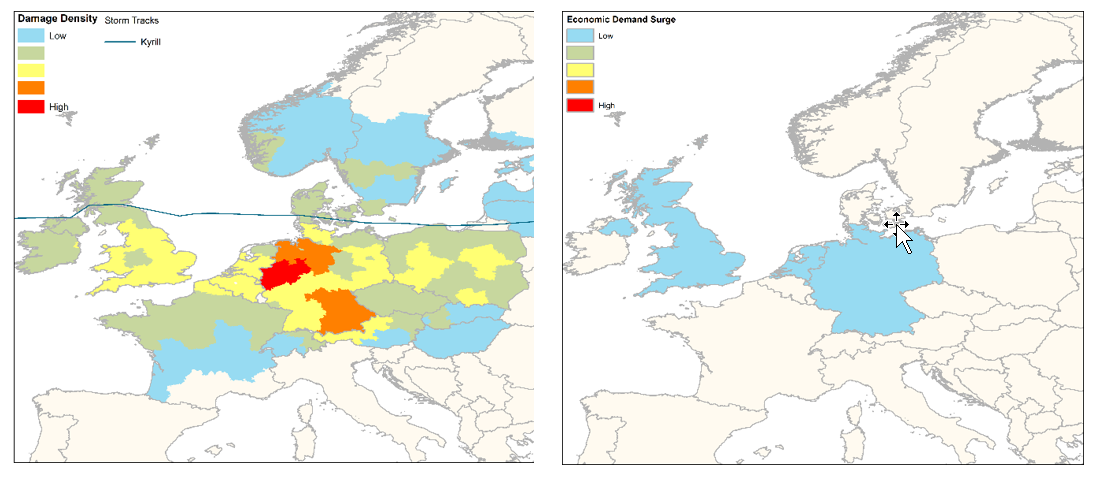
Although the events were widespread, economic demand surge would have been primarily expected in Germany. But the map on the right shows the GDSM at the country level and the uptick is the same everywhere. What we are seeing is an example where there was material market disruption but no local labor market disruption. Materials cost increases were significant, but there was no disruption to the labor market causing a local uptick in Germany.
The table below shows the results of the GDSM for the three most impacted countries and the total for Europe. This includes the flat assumption of 3% comprising the long-term average for cost inflation for materials as a proxy for materials demand surge and general construction labor inflation. While there is a little uptick in labor demand surge in Germany, the Netherlands, and the United Kingdom, it is not significant and may not have been noticed.
For the supporting data in 2007, we can use the Eurostat construction labor index to get a much more realistic understanding of that market. We will still use the PPI to represent the materials trend. For construction statistics we can use the construction repair index for all our countries, but for Europe we will still use the weighted average of the PPI and the CPI.
| Country | GDSM | PPI | EuroStat Construction Labor Index | National construction statistics |
|---|---|---|---|---|
| Germany | 4% | 5% | 1% | 4% |
| Netherlands | 4% | 7% | 2% | 6% |
| United Kingdom | 4% | 4% | 8% | 6% |
The most relevant point in this chart is the comparison between the GDSM factors and the national construction statistics (NCI). The NCI for these countries is relatively flat as the GDSM factors are, but they are a little higher. The difference can be attributed to using the long-term average for cost inflation for materials and economic environment as a proxy for demand surge, rather than the PPI. The GDSM factors are presented with the long-term average inflation because it is what you would see for rate making.
The most important takeaway is that this was a demand surge–causing event, but it is primarily a construction materials demand surge. Any local effects are too small to show up. Because demand surge is subject to many other additional factors beyond a single natural catastrophe, it is important to consider the data concurrent with when an event was happening.