
Case study: 1990 ETC season
This case study reviews historic storms in 1990 that affected Europe, their implications for excess demand for reconstruction, and the impact on costs following the events.
During the winter of 1990, which was warmer than usual, a series of severe storms swept across Europe. Daria, which affected Europe January 25-26, struck an area that had already been struck by a series of storms; in February, after Daria, storms Herta, Wiebke, and Vivian struck. Daria alone—one of the most severe storms to have struck Europe on record—caused considerable damage in six countries; most of the damage was in the United Kingdom. February 26-28, 1990, Vivian and Wiebke both struck Europe as the last of the devastating series of storms that affected Europe that year. These two storms, arriving just four weeks after Daria, caused more damage than Lothar and Martin a decade later.
The figure below shows the storm damage in the left panel with the relative concentration of damage at the sub-national level. The damage map is overlaid with the tracks of the four major storms that year, also highlighting the areas of greatest impact. More than 70% of the losses are in the United Kingdom, Germany, and France, which means that the demand surge in these countries will determine the impact for the whole event. The right panel shows the relative country-level GDSM impact.
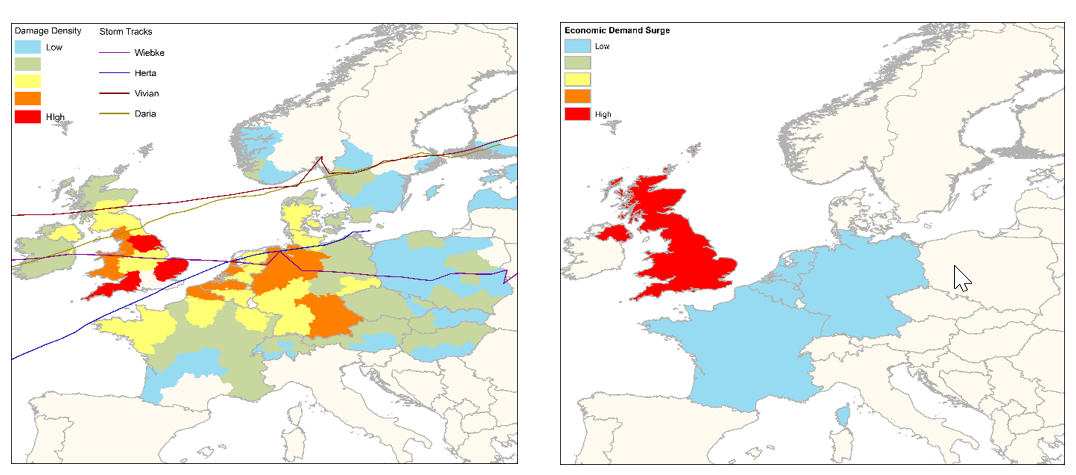
The following table shows the results of the GDSM for the three countries and the total impact for Europe, using a flat assumption of 3% that includes the long-term average for cost inflation for materials as a proxy for materials demand surge and general construction labor inflation; anything beyond that can be attributed to local variation. We can see that for the UK the model predicts about a 7% increase in prices after these events. This is consistent with the higher relative damage in the south and southeast of England. Contrast this with the lower increases in France and Germany where the highest relative damage is a magnitude lower, but the predicted demand surge is negligible—mostly materials demand surge. Outside the most impacted countries, the predicted demand surge drops down to values that are consistent with no or minimal local effects and no increases in cost inflation.
For 1990 the data is limited, so the Organization for Economic Co-operation and Development (OECD) producer price index (PPI) was used to represent the materials trend and the consumer price index (CPI) for the labor trend. For construction statistics, the construction cost index for repair and maintenance indexes are available for France, Germany, and the UK. The first thing to notice is the wide differences in the PPI and the CPI, which is to be expected because this is pre-European Union. It is also likely that the free movement of labor across national borders at the time would have played some part in these results.
| Country | GDSM | PPI | CPI | National construction statistics |
|---|---|---|---|---|
| United Kingdom | 7% | 5% | 6% | 5-9% |
| Germany | 4% | 2% | 4% | 7% |
| France | 4% | 0% | 3% | 4% |