
Quantifying demand surge
We can gain insight into the inflationary effects of catastrophes by tracking material and labor price changes in affected regions in the immediate aftermath of an event.
We use construction cost time series data from XactAnalysis™, a reporting tool created by Xactware, a subsidiary of Insurance Services Office (ISO). XactAnalysis offers Industry Trend Reporting, a service that provides construction labor and material cost information over time. Data from recent events indicate that increased labor costs, as opposed to building materials prices, are the driving force behind demand surge.
Impact of demand surge on material prices
We tracked material prices following the unusually active 2004 and 2005 hurricane seasons. The data indicate that the impact of catastrophe events on building material prices may not be very significant. This may be the result of:
- Large chain stores keeping the prices of building materials constant following large events
- Government regulation and policy changes to control prices following large events
-
Delays in rebuilding due to limited labor, thus spreading the rebuilding work over an extended period of time
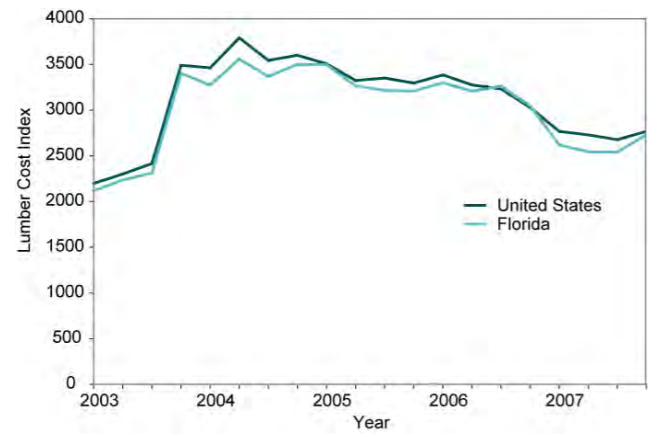
Lumber price indices, 2003-2007 (source: Xactware) shows that while there was a sharp increase in third quarter of 2003, the 2004 and 2005 hurricane seasons do not appear to have had a significant impact on the price of lumber.
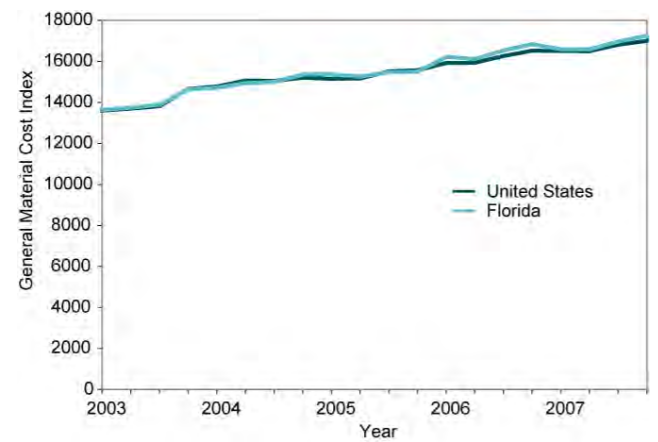
Composite building material indices, 2003-2007 (source: Xactware) shows that while the cost of building materials has been steadily increasing since the start of 2003, there is no evidence of any significant impact from the hurricanes—even in Florida, which in 2004 felt the brunt of four hurricanes in relatively close geographical and temporal proximity.
Impact on labor prices
Another component of construction costs is labor. Unlike the relatively stable prices for building materials seen in the aftermath of the 2004 and 2005 hurricane seasons, labor costs rose significantly. This may be the result of several factors, including:
- Increased demand for available labor given the scope of rebuilding
- Costs associated with importing labor from outside the affected areas
- Per diems paid to workers who are brought into the affected areas during reconstruction
In The impact of the 2004 hurricane season on overall labor costs in Florida is clearly illustrated by the sharp increase in the third and fourth quarters of that year. 1 The effect on labor prices at the national level is much less pronounced. Labor markets tend to be strongly regional; building materials can be transported to the affected region with relative ease—bringing in additional labor resources is more problematic.
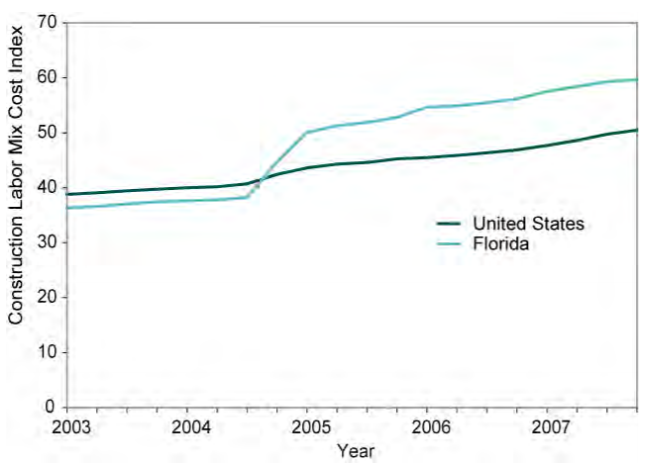
Note that in Composite labor price indices, 2003-2007 (source: Xactware), the Florida labor market barely recognizes the 2005 losses from Hurricanes Katrina, Rita, and Wilma, again pointing to the regional nature of labor markets, at least in the short term.2
 Shows
the impact of the 2004 and 2005 hurricane seasons on roofing labor costs in the U.S.,
Florida and Fort Myers, FL
Shows
the impact of the 2004 and 2005 hurricane seasons on roofing labor costs in the U.S.,
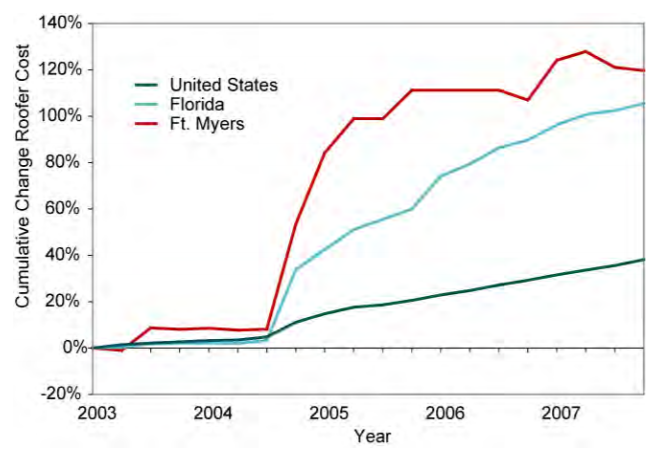
Florida and Fort Myers, FLRoofing labor price indices, 2003-2007 (source: Xactware) shows the impact of the 2004 and 2005 hurricane seasons on roofing labor costs in the U.S., Florida and Fort Myers, FL, which was impacted by Hurricane Charley and, to a lesser extent, Hurricanes Frances and Jeanne during the 2004 season. Note again the significant jump beginning in the third quarter of 2004.