Post-event construction cost inflation
Post-event construction cost inflation captures construction cost increases over the average time required to rebuild and settle claims.
Large catastrophes often delay reconstruction due to emergency response activities, extensive cleanup, permitting constraints, and limited contractor availability. Infrastructure damage, supply chain disruptions, and government intervention can further extend claim settlement timelines.
Claims settled months to multiple years after an event are exposed to additional cost inflation that would not apply to immediate repairs. This component is modeled dynamically at the state- and peril-level and scales with estimated claim settlement duration. Shorter settlement timelines result in lower inflation impacts, while longer timelines lead to higher cost increases.
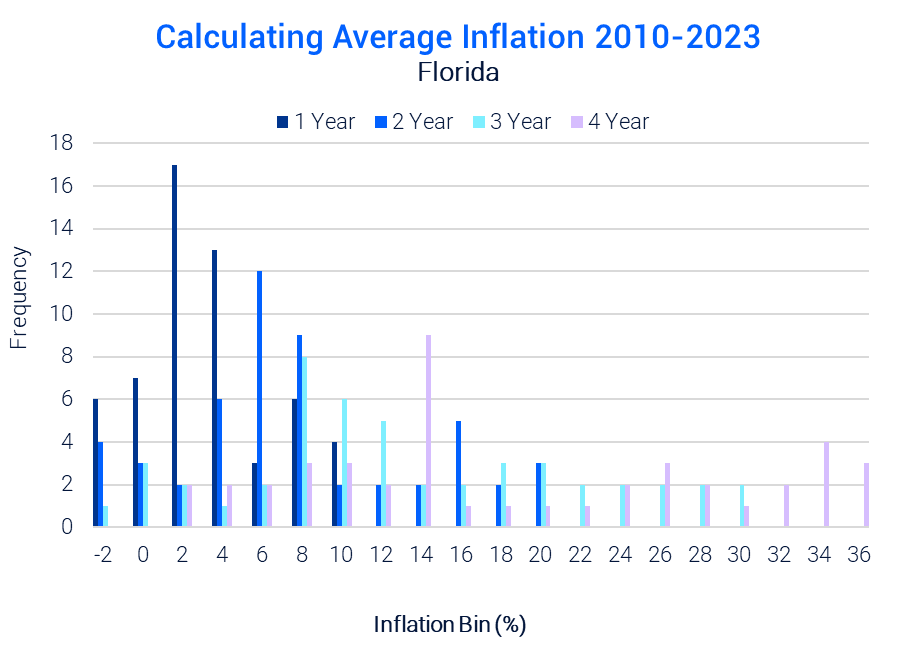
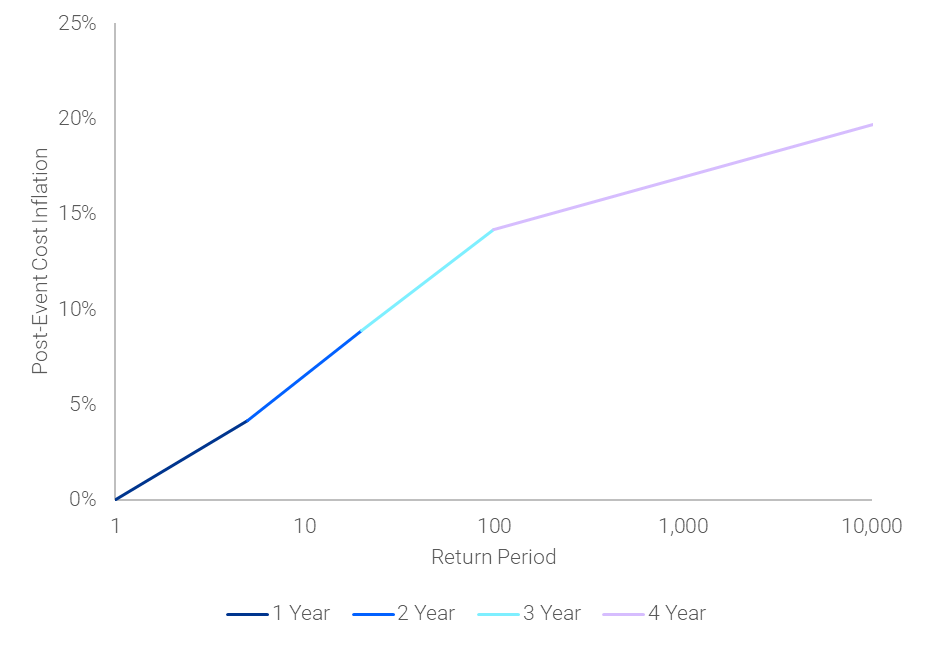
The figure below explains post-event construction cost inflation by return period for Florida for the U.S. tropical cyclone model. This component is using historical reconstruction cost inflation trends for each state and calibrated using historical reconstruction timelines from real-world events. The post-event construction cost inflation component is applied to all years in the catalog and is dependent on aggregate annual losses in each state.
Parameters defining the model are determined using historical construction cost inflation averages from 2010-2023 for each state as shown in the next figure and applied based on average reconstruction timelines by return period. Post-event construction cost inflation is based on assumed reconstruction timelines. In Florida, for example, it is assumed that repair timelines can range between 0 and 4 years and the length will be dependent on the return period of industry losses in a year. Assumptions for claim settlement timelines were derived empirically using historical data on repair timelines from real-world events.