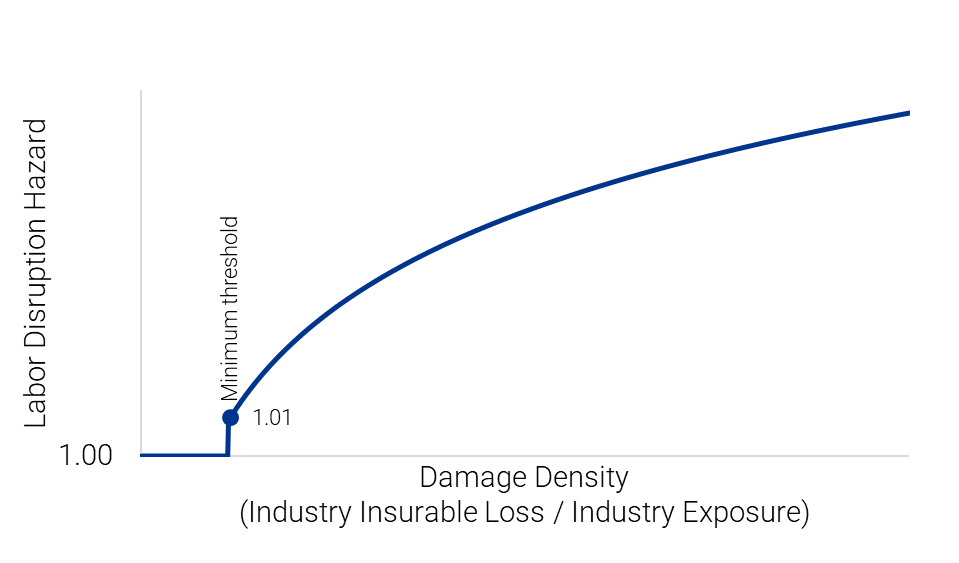
Labor disruption hazard
The labor disruption hazard component captures the potential increase in construction labor costs caused by an insufficient local supply of workers following a catastrophe.
After large events, local construction labor capacity can become overwhelmed, requiring additional workers to enter the construction workforce, either from the surrounding local region or from out of state. As demand for labor increases, wages rise to attract these additional workers, leading to higher reconstruction costs.
The figure below describes the approach for modeling the labor disruption hazard component. Labor disruption is modeled for each peril and state, and responds to the severity of the largest event loss in a given catalog year. The component is triggered only when a sufficiently large event exceeds a minimum damage density threshold. Damage density is used to normalize industry insurable losses by the total value of exposure in the state. Below this threshold, the labor market is assumed to be able to absorb the additional demand without significant wage effects. Once triggered, the resulting labor shortage affects all events in the same state during that catalog year, reflecting a sustained disruption to the construction labor market throughout the catalog year.